Binstock & Sons
Memorials
Chinese Memorial Guidance

Chinese Headstone Wording
Characters & Traditions

A complete guide to Chinese monument wording, character inscriptions, gold leaf lettering, ceramic portraits and Qingming customs. Family-run monumental masons serving Sydney's Chinese community since 1958.

Call (02) 9746 7696

Finding the Right Words

This guide covers what typically appears on a Chinese monument in Sydney — the character inscription structure, the calligraphic and material choices at the heart of Chinese memorial design, and the ancestral traditions (Qingming, Chongyang, and family observances) that shape when a monument is built and used.

We've built Chinese monuments across Rookwood, Macquarie Park, and Macarthur Memorial Park for more than 65 years. To discuss your family's memorial, call us on (02) 9746 7696.

Inscription

Elements of a Chinese Inscription

Chinese monuments in Sydney are typically bilingual — Chinese characters alongside English — with the character inscription following traditional structural conventions. The elements below appear on the majority of monuments we build for Chinese families.

Full name (Chinese and English)

Most Chinese-Australian monuments in Sydney are bilingual — Chinese characters alongside the deceased's English name. Chinese names are written with the family name (surname) first, followed by the given name (e.g. 陳志明 — Chen Zhiming). For older-generation families, Chinese-only inscriptions remain traditional. Both simplified and traditional characters are used, depending on the family's regional origin (Hong Kong, Taiwan and older diaspora families typically use traditional characters; mainland China families often prefer simplified).

Honorific opening — "先" / "顯"

Traditional Chinese inscriptions begin with an honorific character indicating the deceased is a revered elder or parent. "先" (xiān — "the late" or "deceased of blessed memory") precedes the name for a deceased parent. "顯考" (xiǎn kǎo) means "esteemed late father"; "顯妣" (xiǎn bǐ) means "esteemed late mother". These forms carry deep respect and are near-universal on traditional monuments.

Dates of birth and death

Both dates are almost always included, formatted DD/MM/YYYY or YYYY年MM月DD日 in Chinese style. Some monuments include both Gregorian and lunar (陰曆 — yīnlì) dates, particularly if the family observes traditional Chinese festivals tied to the lunar calendar. Traditional inscriptions may use 生於 (shēng yú — "born on") and 卒於 (zú yú — "died on") before each date.

Ancestral home (jiaxiang / 家鄉)

Chinese memorial tradition places strong emphasis on the ancestral village, town or region — the "jiaxiang" (家鄉). This connects the deceased to their family lineage across generations. Common formats include "廣東省 [village name]" ("Guangdong Province, [village name]") or "祖籍 [region]" ("Ancestral home: [region]"). Particularly important for the migrant generation and their children.

Children and family (孝男 / 孝女)

Traditional Chinese monuments list the deceased's surviving children as filial sons and daughters ("孝男" — xiào nán, "孝女" — xiào nǚ). Grandchildren may also be listed. This centres the monument on family lineage and filial piety (孝 — xiào), which is core to Chinese memorial tradition. Names are typically listed in birth order.

Closing tributes

Common closings include "永垂不朽" (yǒng chuí bù xiǔ — "eternally remembered"), "安息" (ān xī — "rest in peace"), "音容宛在" (yīn róng wǎn zài — "your voice and image remain with us"), and "德高望重" (dé gāo wàng zhòng — "of high virtue and esteem"). English equivalents include "In loving memory of," "At peaceful rest," and "Forever remembered."

Design

Visual Elements & Craftsmanship

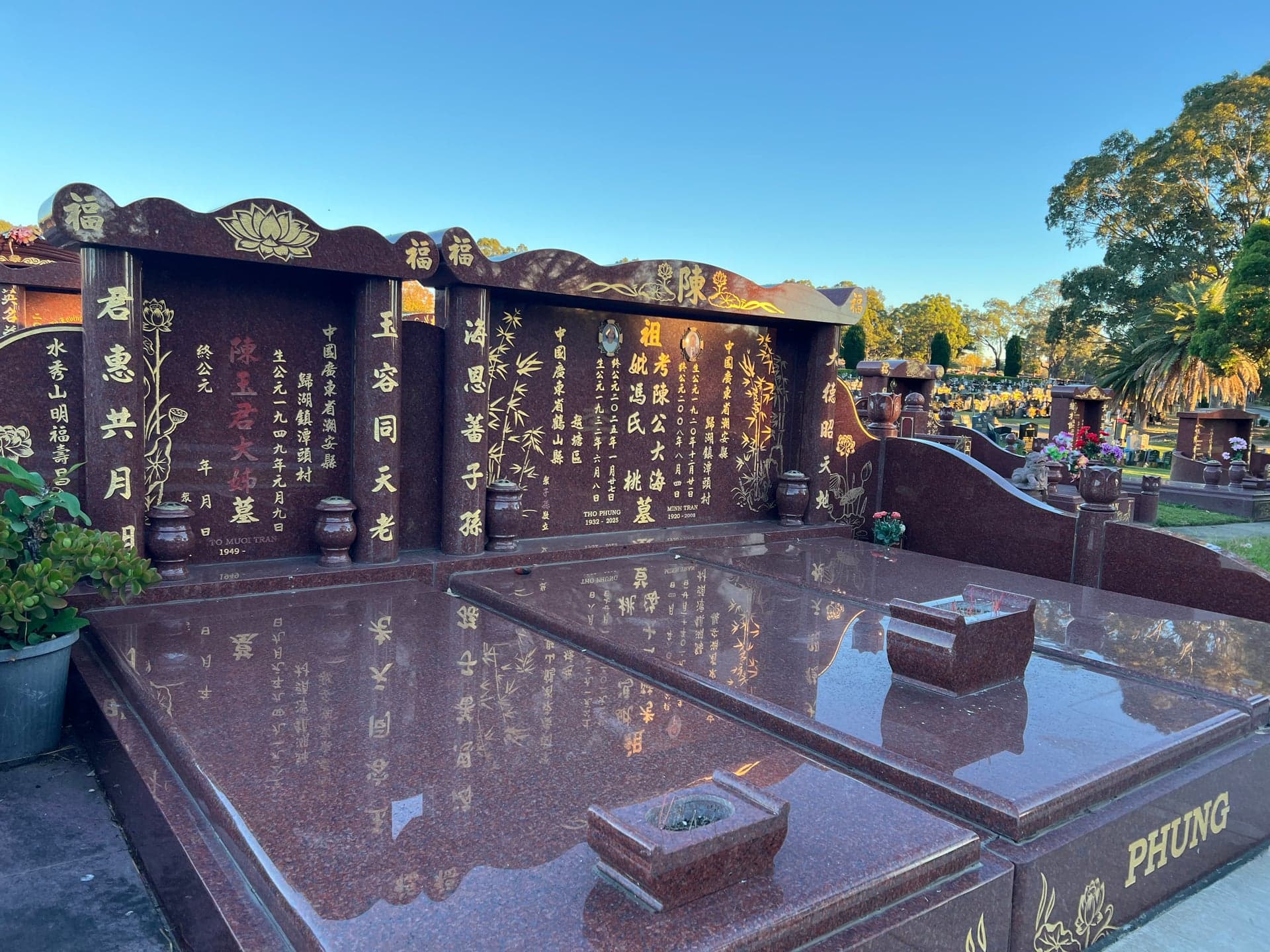
Unlike Western monuments where iconography is central, Chinese memorials place the calligraphic quality of the characters themselves at the visual heart — supported by traditional finishes, portrait photography, and functional fixtures for ancestor veneration.

Chinese characters as the primary visual element

Unlike Western monuments where iconography is central, Chinese memorials place the characters themselves at the visual heart of the monument. The calligraphic quality — the strength and beauty of the character forms — carries the memorial's dignity. Correct character selection (simplified vs traditional), stroke integrity, and proper spacing are essential.

Gold leaf lettering

Gold leaf is the traditional lettering choice for Chinese monuments — considered the most respectful and enduring finish. The rich, warm appearance signals reverence and prosperity for the family. Most Chinese families choose gold leaf over painted or cut-in alternatives, and it maintains its appearance for decades without significant weathering.

Ceramic portrait photograph

Ceramic portraits are widely included on Chinese-Australian monuments, honouring the deceased with a personal image. The photograph is fired onto porcelain in oval or rectangular format and mounted directly to the granite. Photos last 50+ years outdoors and are considered an important part of the memorial for many families.

Vase holders and offering platform (供台)

Chinese monuments almost always include a dedicated platform (供台 — gōng tái) for offerings during Qingming and other ancestral ceremonies. Vase holders for flowers, incense holders, and space for food offerings (fruit, rice, roast meats) are built into the monument design. These are practical fixtures for the family's regular ancestor veneration, not decorative additions.

Family crest and lineage markers

Some Chinese monuments incorporate the family surname prominently at the top (堂號 — táng hào, the family hall name), which serves as a lineage marker across generations. This is particularly traditional for family plots planned to hold multiple generations.

Auspicious symbols

Selected traditional Chinese symbols may be incorporated where appropriate — the lotus (蓮花 — Buddhist symbolism), clouds (雲紋 — auspicious motifs), or subtle carved patterns. These are typically restrained rather than elaborate; the monument's dignity comes from the calligraphy and stone quality, not from decoration.
Traditions

Ancestral Ceremonies & Timing

Qingming Festival (清明節)

Qingming ("Tomb-Sweeping Day") falls in early April each year and is the most important observance in Chinese memorial tradition. Families gather at ancestors' graves to clean the monument, burn incense, offer food, and pay respects. The monument's offering platform and vase holders are used during this observance. Many Chinese-Australian families aim to have the monument installed before their first Qingming after the passing.

Chongyang Festival (重陽節)

The Double Ninth Festival (9th day of the 9th lunar month, typically October) is another significant day for ancestor veneration and cemetery visits. Elders are honoured on this day, and families often visit graves to pay respects.

Anniversary observance and Chinese New Year

Chinese families typically visit the grave on the anniversary of the death, at Chinese New Year (春節 — Chūn Jié), and on other significant dates. The monument is the focal point for these gatherings — worth building with permanence, prominence and functional offering fixtures in mind.

Feng Shui considerations

Some Chinese families consider feng shui (風水) principles when planning the monument — its orientation, materials and proportions. Where relevant, we work with families and their feng shui consultants during the design phase to ensure the monument meets both aesthetic and traditional criteria.

Regional and dialect community variations

Sydney's Chinese community includes families from Hong Kong, mainland China (particularly Guangdong and Fujian), Taiwan, Malaysia, Singapore, Vietnam and the wider diaspora. Cantonese-speaking, Mandarin-speaking, Hokkien and Teochew families may have slightly different memorial customs. We adapt to your family's specific tradition rather than assuming a single Chinese template.

Where We Work

Every Chinese Section in Sydney

Binstock & Sons builds Chinese monuments across every major Sydney cemetery — Rookwood (Chinese monumental and lawn sections), Macquarie Park (Chinese monumental section), and Macarthur Memorial Park (Chinese monumental section). Our masons know each cemetery's specific rules around dimensions, materials, ceramic photographs and offering platforms.

For a full overview of our Chinese monument work, see our Chinese Headstones page →

Questions

Frequently Asked Questions

Do you engrave Chinese characters accurately?

Yes. We have extensive experience setting out both simplified and traditional Chinese characters, and we understand the importance of stroke integrity, correct forms, and proper spacing. We prepare a detailed proof of every inscription and send it to the family for approval — often to a Chinese-speaking family member — before engraving begins. Nothing is cut until you sign off.

Simplified or traditional characters?

The family's choice, based on regional origin and personal preference. Traditional characters (繁體字) are typical for families from Hong Kong, Taiwan and the older diaspora. Simplified characters (简体字) are typical for families from mainland China. Some families use both — for example, traditional for the ancestral home reference and simplified for the family name. We follow your preference.

How does the ceramic photograph process work?

You supply us with a high-quality photograph of the deceased. We work with a specialist ceramicist who fires the image onto porcelain in oval or rectangular format. The finished ceramic is then mounted onto the monument. Ceramic photos last 50+ years outdoors and can be replaced or added later if needed.

Can we include the ancestral home (jiaxiang) on the monument?

Absolutely, and we encourage it. It's a deeply meaningful detail for Chinese families, connecting the deceased to their lineage across generations. The ancestral home is typically included in Chinese characters (e.g. 廣東省中山縣) alongside or below the name.

Can we include the offering platform and vase holders?

Yes — these are built into the monument during the design phase, not added on afterward. We plan the offering platform (供台) and vase holders based on your family's traditions and the monument's dimensions. If you observe Qingming or other ancestral ceremonies regularly, this is essential.

What granite colours are traditional for Chinese monuments?

Dark granites (jet black, ruby red, and dark greys) are the most common choices in the Chinese community — considered dignified and enduring. Red granite in particular carries auspicious meaning in Chinese tradition. We have over 25 granite colours to choose from and can advise on cultural appropriateness for your family's tradition.

How soon should we install the monument?

Many Chinese families aim to have the monument installed before their first Qingming (early April) after the passing. Our typical timeframe is 8-12 weeks from design approval to installation. If you're working toward Qingming or another specific date, contact us as early as possible so we can plan the timeline together.

Get in Touch

Ready to speak with us?

Our experienced masons help Sydney Chinese families through every step of the memorial process — Chinese and English wording, gold leaf finishes, ceramic portraits, offering platforms, and preparation ahead of Qingming.

Call (02) 9746 7696