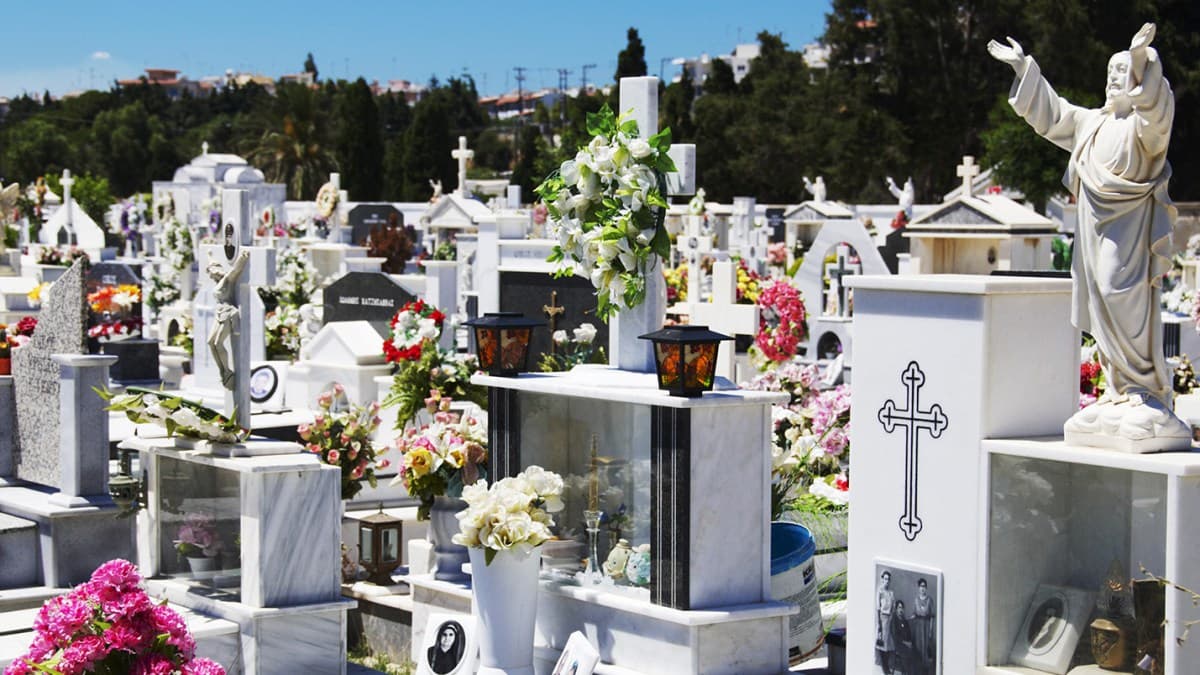
A complete guide to Greek Orthodox monument wording, inscriptions, symbols and the 40-day memorial. From Sydney's family-run monumental masons since 1958.
Greek Orthodox monuments carry some of the most distinctive design conventions of any community we work with in Sydney. The three-bar Orthodox cross, the ceramic photograph, the closing phrase “Αιωνία η μνήμη”, and the tight timeline driven by the 40-day memorial all shape how a Greek monument is designed and installed.
This guide covers what typically appears on a Greek Orthodox headstone, the meanings behind the traditional symbols, and the key ceremonies and dates that families should be aware of when planning a memorial.
We've built Greek Orthodox monuments across Rookwood, Woronora, Botany, Eastern Suburbs and Macarthur Memorial Park for more than 65 years. If you'd like to discuss your family's specific memorial, we're available on (02) 9746 7696.
A traditional Greek Orthodox headstone in Sydney is typically bilingual (Greek and English) and follows a recognised structure. The elements below appear on the majority of monuments we design, though the balance of Greek to English varies from family to family.
Traditional Greek Orthodox monuments carry the deceased's full name in both Greek and English, or Greek only for older-generation families. Names are usually given in the format [First name] [Family name], with the family name (surname) in the genitive case for wives ("Papadopoulou" rather than "Papadopoulos" for a woman married into the family).
The traditional Greek opening is "Εδώ αναπαύεται" (Edo anapavetai), meaning "Here rests" or "Here reposes". For a man the form is "αναπαύεται ο" (anapavetai o), and for a woman "αναπαύεται η" (anapavetai i). Some inscriptions also open with "Εδώ κείται" (Edo keitai — "Here lies").
Both dates are typically included, in the format DD/MM/YYYY. Some monuments include the phrase "Γεννήθηκε" (Yennithike — "Was born") and "Απεβίωσε" (Apeviose — "Passed away") before each date. Others use just the Greek abbreviation ✝ (cross) before the death date to indicate it.
Greek monuments almost always include the relationship of the deceased — "Beloved husband and father of…", "Adored wife and mother of…", or the Greek equivalents such as "Λατρευτός σύζυγος και πατέρας" (Latrevtos syzyghos kai pateras — "Beloved husband and father"). Sons and daughters, grandchildren, and sometimes godchildren are listed by name.
"Αιωνία η μνήμη" (Eonia i mnimi — "Eternal be their memory") is the universal Greek Orthodox closing. It is the phrase sung at every memorial service and appears on almost every Greek Orthodox monument in Sydney. Some inscriptions extend this to "Αιωνία αυτού/αυτής η μνήμη" (Eonia aftou/aftis i mnimi — "Eternal be his/her memory").
Many Greek-Australian families include the village or region the deceased came from in Greece — for example, "Γεννηθείς εν [village name], [region]" (born in [village], [region]). This is a strong tradition for the first migrant generation and is often continued for their children.
Greek Orthodox monuments are visually rich, with strong symbolic elements that immediately identify the deceased's faith. The most common visual features include:
The three-bar cross with the slanted lower bar is the primary symbol of Greek Orthodox monuments. It differs from the Latin (Catholic) cross in that it has three horizontal bars: a small top bar for the inscription, the main crossbar, and an angled footrest. It appears prominently on nearly every Greek Orthodox headstone.
Four letters that appear in each quadrant of the Greek cross: I-C on the top left and right, X-C on the middle left and right. Together they form "Ιησούς Χριστός Νικά" (Jesus Christ Conquers). NIKA (Νικά, "conquers") often appears below the cross. This is a highly traditional Orthodox marking.
Ceramic photographs are near-universal on Greek Orthodox monuments in Sydney — a defining feature of Greek memorial design. The photograph is fired onto porcelain and mounted directly onto the granite or marble. Oval and rectangular formats are the most common. Photos are extremely durable and typically last 50+ years outdoors.
Etched or ceramic icons of Christ, the Virgin Mary (Παναγία, Panagia) or the deceased's patron saint are sometimes included on more elaborate monuments. These are traditional and can be beautifully rendered in engraved granite.
Small etched images of a Greek Orthodox church, the family's home church in Greece, or the local Sydney parish are sometimes included on the monument as a personal touch.
Etched or carved images of the traditional Greek oil lamp (Καντήλι), which burns continuously in Orthodox homes and churches, appear on some monuments as a symbol of the deceased's faith.
The 40-day memorial (Sarantimero) is one of the most important observances in Greek Orthodox tradition. The soul is believed to complete its final journey on the 40th day after death, and the family gathers for a memorial service (mnimosino) at the graveside or in the church. Many families aim to have the headstone installed by the 40-day memorial — an important consideration when planning timing.
The 40-day memorial creates a natural deadline for headstone installation in Greek Orthodox practice. In our experience most Greek Sydney families want the monument in place before this date. This is achievable in most cases if the monument is ordered within 2–3 weeks of the funeral, though timeframes depend on cemetery ground conditions and design complexity. We'll always give you a realistic timeline upfront.
Beyond the 40-day memorial, Greek Orthodox tradition observes further memorials at 3 months, 6 months, 9 months, and 1 year — and often annually thereafter. Each is an opportunity for family to gather at the graveside. The monument becomes the focal point of these gatherings for decades.
Greek Orthodox families in Sydney are strongly represented at Rookwood (Greek Orthodox sections), Woronora Memorial Park, and Botany Cemetery. Each cemetery has slightly different rules around monument dimensions, materials and photographic ceramics — we know these requirements intimately and design accordingly.
Binstock & Sons builds Greek Orthodox monuments across every major Sydney cemetery — Rookwood, Woronora Memorial Park, Botany Cemetery, Eastern Suburbs Memorial Park, Macarthur Memorial Park and Frenchs Forest. Our masons know each cemetery's specific rules around dimensions, materials and ceramic photographs.
For a full overview of our Greek Orthodox monument work, see our Greek Headstones page →
For traditional Greek Orthodox families the Greek inscription is essential — particularly the closing phrase "Αιωνία η μνήμη". Younger generations sometimes opt for English-only, but the majority of Greek monuments we build are bilingual, with Greek text alongside English. We can help you decide on the balance.
You supply us with a high-quality photograph of the deceased. We work with a specialist ceramicist who fires the image onto porcelain in either oval or rectangular format. The finished ceramic is then mounted onto the monument. Ceramic photos are extremely long-lasting and can be replaced or added later if needed.
Most Sydney cemeteries permit ceramic photographs on Greek Orthodox monuments, though there are some sections and cemeteries where they are restricted or require specific formats. We check the requirements of your specific cemetery section before design begins.
Absolutely — and we encourage it, particularly for the migrant generation. It's a meaningful detail that anchors the monument to the family's heritage. The village name is typically included in Greek script.
This is very common for Greek families and we understand the importance of the deadline. In most cases we can complete a monument within 4–6 weeks of the order, provided the design is finalised quickly and cemetery ground conditions permit. Get in touch as soon as possible after the funeral if this is your goal.
We prepare a detailed proof of the full inscription — Greek and English — and send it to the family for approval before engraving begins. If needed, we can also coordinate a review by your priest or a family member fluent in Greek. Nothing is engraved until you sign off.
Our experienced masons help Sydney Greek Orthodox families through every step of the memorial process — Greek and English wording, ceramic photographs, cemetery liaison and installation ahead of the 40-day memorial.