
A complete guide to Italian monument wording, symbols, ceramic photographs and regional traditions. Family-run monumental masons serving Sydney's Italian community since 1958.
This guide covers what typically appears on an Italian Catholic monument in Sydney: the structure of the inscription, the symbols at the heart of Italian memorial design, the role of ceramic photography, and the regional traditions that vary across Sydney's Italian community.
We've built Italian Catholic monuments across Rookwood, Botany, Frenchs Forest, Waverley, Field of Mars and Macarthur Memorial Park for more than 65 years. To discuss your family's memorial, call us on (02) 9746 7696.
Italian monuments in Sydney typically include both English and Italian phrasing, with a strong emphasis on family, heritage and regional identity. The elements below appear on the majority of monuments we build for Italian families.
The full baptismal name of the deceased. Italian families often include the middle name or confirmation name and, for women, the maiden name in parentheses or after 'nata' (born). Common format: [First name] [Middle name] [Family name] (nata [Maiden name]).
"In loving memory of" and "In memoria di" are the two most common openings on Italian Catholic monuments in Sydney. Older-generation families often prefer the Italian phrasing. "In ricordo di" ("In memory of") is another traditional choice. Some monuments open with the family surname above the name in a larger typeface, a common Italian design pattern.
Both dates are almost always included on Italian monuments, formatted as DD/MM/YYYY. Traditional inscriptions may use "Nato/Nata il" ("Born on") and "Morto/Morta il" ("Died on") before each date, though modern monuments often just show the dates alongside the name.
One of the most distinctive features of Italian monuments in Sydney is the inclusion of the deceased's town, village or region of birth in Italy. Formats like "Nato a [town], [province]" or "Da [town]" appear on the majority of first-generation Italian monuments. This is a strong tradition and worth including even for second- and third-generation families as an anchor to heritage.
"Beloved husband and father of…", "Amato marito e padre di…", "Adored wife and mother of…", "Amata moglie e madre di…" — Italian monuments almost always list the surviving spouse, children and often grandchildren by name. In traditional Italian families this is an essential part of the inscription, not an optional addition.
"R.I.P." (Requiescat in Pace) and its Italian equivalent "Riposa in pace" are the most common closings. Other traditional phrases include "Sempre nei nostri cuori" ("Always in our hearts"), "La tua memoria vivrà per sempre" ("Your memory will live forever"), and the Latin "In Paradisum" ("Into paradise"). Marian invocations such as "Sotto la protezione della Madonna" ("Under the protection of the Madonna") appear on more devotional monuments.
Italian Catholic monuments carry some of the richest symbolic vocabulary of any community we work with. The most-used symbols on Sydney Italian monuments include:
The Latin cross is the primary symbol on almost every Italian Catholic monument. It may be plain, ornate, or feature the corpus (crucifix with the figure of Christ). The crucifix in particular is a strong Italian tradition, more common on Italian monuments than on many other Catholic denominations.
The Sacred Heart of Jesus — a flaming heart wrapped in thorns, often surmounted by a cross — is one of the most beloved Italian Catholic symbols. Devotion to the Sacred Heart is particularly strong in Italian tradition, and the image appears on a large share of Italian monuments in Sydney.
Images of the Virgin Mary are central to Italian Catholic memorial design. Common variants include the Madonna of Sorrows (Addolorata), Our Lady of Mount Carmel (Madonna del Carmine), Our Lady of Pompei (Madonna di Pompei), and regional Madonnas from the family's home town. Etched or carved onto the granite, or included as a ceramic image.
Ceramic photographs are near-universal on traditional Italian monuments — arguably more central to Italian design than any other Catholic community in Sydney. The photograph is fired onto porcelain and mounted directly onto the granite, usually in an oval or rectangular format. Photos are extremely durable and last 50+ years outdoors.
Praying hands with rosary beads wrapped around them are a common Italian Catholic symbol, reflecting the central role of the rosary in Italian devotional life. Particularly common on monuments for grandmothers and older parishioners known for daily rosary practice.
Etched or carved images of the deceased's patron saint — often the saint of their name day (onomastico) or their hometown's patron saint — are commonly included. Padre Pio, Saint Anthony (Sant'Antonio), Saint Joseph (San Giuseppe), Saint Francis (San Francesco) and the patron saints of specific Italian regions appear frequently.
Some monuments incorporate small etched images that reference the family's town or region — a coastal scene for a family from Calabria, an alpine motif for a family from the Veneto, olive branches for southern Italian heritage. Personal, deeply meaningful for the family, and quietly beautiful.
Angels (especially guardian angels) and doves (representing the Holy Spirit and peace) are commonly incorporated into Italian monument design, often carved into the top of the headstone or included as ceramic elements.
Italian Catholic families typically install a monument within 12 months of burial, though there is no strict theological deadline. Many families aim to have the monument ready before the first anniversary of death (l'anniversario) so it is in place for the anniversary mass. Some families prefer to install sooner, others take longer — timing is a family decision, not a religious obligation.
Many Italian families arrange for their parish priest to bless the newly-installed monument. The blessing is typically brief — sprinkling of holy water, prayers for the deceased and family, sometimes a short reading from scripture. We coordinate our installation timing with the family's parish so the blessing can proceed without delay after installation.
Italian Catholic tradition places strong emphasis on the anniversary mass (Messa d'anniversario) held each year on the anniversary of death, and on the annual observance of All Souls' Day (Il Giorno dei Defunti / Il Giorno dei Morti) on November 2. Many Italian families visit graves in force on All Souls' Day, leaving flowers and lighting candles. The monument is the focal point for these annual gatherings.
Sydney's Italian community includes families from every region of Italy — the Veneto, Calabria, Sicily, Puglia, Abruzzo, Campania, Lazio, Friuli, and more. Regional traditions vary meaningfully: Southern Italian families often prefer more devotional imagery (Sacred Heart, Madonna, ceramic photos), while Northern Italian families sometimes lean toward simpler designs. We adapt to your family's specific traditions and preferences.
Italian families often plan family plots from the outset, with a large monument that will accommodate multiple family members over time. Second and later inscriptions are added on-site as needed. We build monuments with future inscriptions in mind — matching lettering style, granite, and layout precisely when the time comes.
Binstock & Sons builds Italian monuments across every major Sydney cemetery, Rookwood, Botany, Frenchs Forest, Waverley, Field of Mars, Woronora and Macarthur Memorial Park. Our masons know each cemetery's specific rules around dimensions, materials and ceramic photographs.
For a full overview of our Italian monument work, see our Italian Headstones page →
Not required, but the vast majority of Italian monuments we build in Sydney include at least some Italian phrasing — commonly the opening ("In memoria di"), the closing ("Riposa in pace"), or reference to the family's town of origin. It anchors the monument to heritage and honours older-generation family members who may have preferred Italian as their first language.
You supply us with a high-quality photograph of the deceased. We work with a specialist ceramicist who fires the image onto porcelain in oval or rectangular format. The finished ceramic is then mounted onto the monument. Ceramic photos are extremely long-lasting (50+ years outdoors) and can be replaced or added later if needed.
Most Sydney cemeteries permit ceramic photographs on Italian Catholic monuments — including Rookwood, Botany, Frenchs Forest, Waverley, Field of Mars and Woronora. Some sections have specific size or placement rules. We check the requirements of your specific cemetery section before design begins.
Absolutely, and we encourage it. It's one of the most meaningful details on an Italian monument, particularly for first- and second-generation Italian-Australian families. The town name is typically included in Italian (e.g. "Nato a Ragusa, Sicilia") near the dates or below the name.
Yes. Whether it's Padre Pio, Sant'Antonio, San Giuseppe, the Madonna del Carmine, the Madonna di Pompei, or a regional patron saint from your family's town, we can etch or carve the image into the monument, or include it as a ceramic. Bring us a reference image and we'll design the monument around it.
After installation, we coordinate with your family's parish so the priest can perform the benedizione della tomba at a time that suits the family. The blessing typically takes 10-15 minutes graveside and involves prayers, holy water, and sometimes a short scripture reading. We time the installation so the blessing can happen shortly after.
Yes. We've built Italian Catholic monuments across every major Sydney cemetery for over 65 years, including all the Italian sections at Rookwood (particularly the traditional Catholic zones), Botany, Frenchs Forest, Waverley, and Field of Mars. We know each cemetery's specific rules and design accordingly.
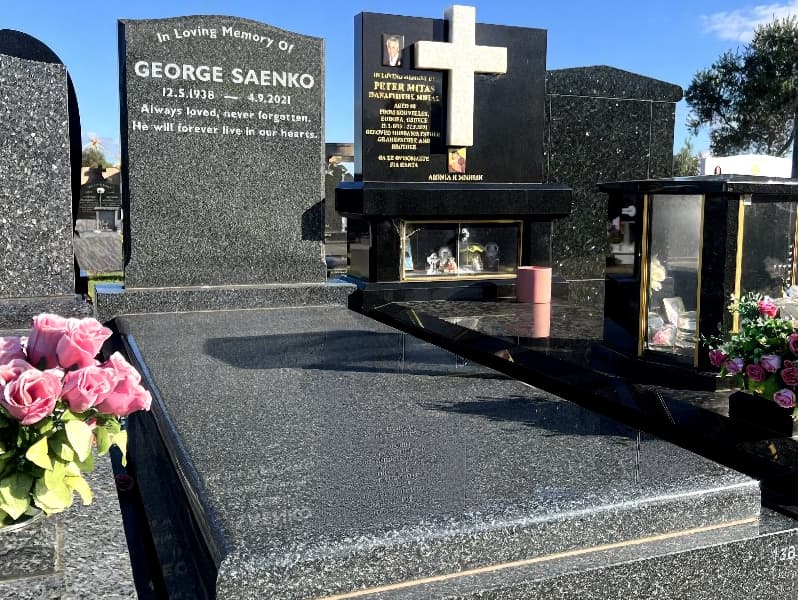
Our experienced masons help Sydney Italian families through every step of the memorial process — wording in Italian and English, ceramic photography, patron saint imagery, and coordination with your parish priest.