Jewish Memorial Guidance
Jewish Headstone Wording
Hebrew & English Guide
A complete guide to the wording, structure and symbolism of Jewish memorial inscriptions. From Sydney's family-run monumental masons since 1958.
A complete guide to the wording, structure and symbolism of Jewish memorial inscriptions. From Sydney's family-run monumental masons since 1958.
This guide covers what typically appears on a Jewish monument, how the Hebrew structure works, which symbols mean what, and the timing and denominational customs that affect the design.
We've built Jewish monuments in every major Sydney cemetery , Rookwood, Macquarie Park, Woronora, Eastern Suburbs, Macarthur and Frenchs Forest, for more than 65 years, across Orthodox, Conservative and Progressive sections. If you'd like to discuss your family's specific memorial, we're always available on (02) 9746 7696.
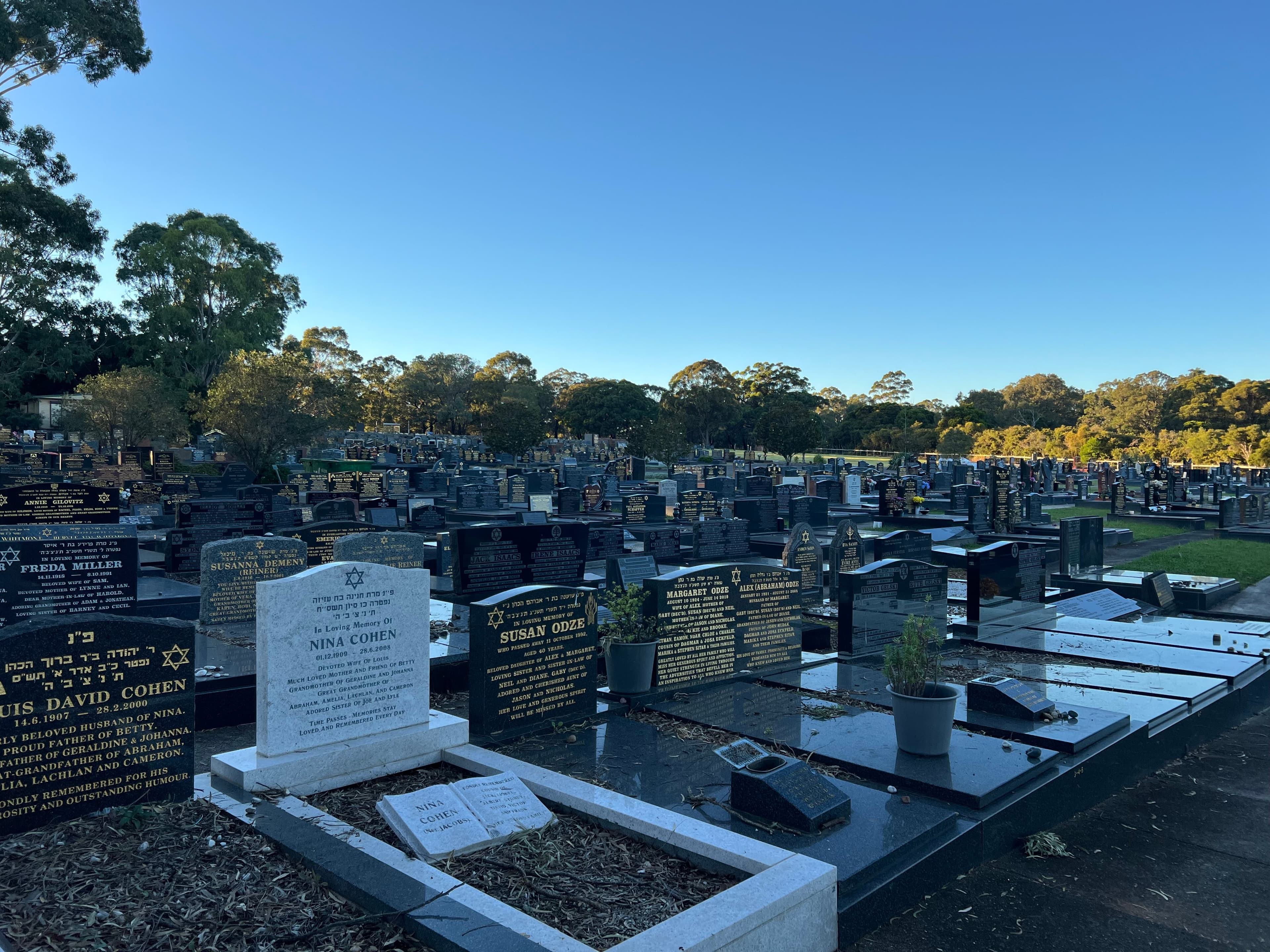
Almost every Jewish headstone in Sydney follows the same four-part Hebrew structure. It has remained essentially unchanged for centuries and connects the monument to the wider Jewish memorialisation tradition.
The traditional opening abbreviation on almost every Jewish headstone. פ״נ (pey-nun) stands for 'Po Nikbar' for a man or 'Po Nikberet' for a woman, both meaning 'Here lies buried'. Some Sephardi and Chassidic communities use פ״ט instead (Po Tamun, 'Here is hidden').
The full traditional Hebrew name follows the format [Given name] בן/בת [Father's Hebrew name]. 'Ben' (בן) means 'son of', 'Bat' (בת) means 'daughter of'. Some families also include the mother's name, particularly in Reform practice or when the mother's Jewish lineage is being emphasised. Kohanim (descendants of the priestly line) typically add הכהן; Levites add הלוי.
Traditionally only the date of death is included on Jewish monuments, not the date of birth. The date is given in the Hebrew calendar: day, month and year. The Hebrew year is often written without the thousands digit (e.g., תשפ״ד for 5784). Your rabbi or funeral director can supply the correct Hebrew date if you're unsure.
The universal closing abbreviation on Jewish monuments. Stands for 'Tehe Nishmato/Nishmata Tzrurah B'tzror HaChaim', a quotation from the biblical book of Samuel. Appears on virtually every Jewish headstone regardless of denomination.
Modern Jewish monuments in Sydney are almost always bilingual. The English inscription runs alongside the Hebrew and tells the story to future generations, friends and family who may not read Hebrew. Common elements include:
Common Jewish openings include "In loving memory of", "In cherished memory of", "In blessed memory of", or the Hebrew phrase transliterated: "May his/her memory be a blessing" (Zichrono/Zichrona Livracha, often abbreviated Z"L after the name).
The full legal name of the deceased, as commonly used during their lifetime. Middle names and preferred names or nicknames are sometimes included depending on family preference.
Unlike traditional Hebrew inscriptions, English inscriptions typically include both dates, date of birth and date of passing, in the Gregorian calendar. The format is usually DD Month YYYY.
Who this person was to the family. Common Jewish phrasings include "Beloved husband of [Name], father of [Names] and grandfather of [Names]", "Devoted wife, mother and grandmother", or "Adored son / daughter / brother / sister".
A personal message that captures the essence of the person, a verse, a proverb, a quality that defined them. Common Jewish closings include "May her soul be bound in the bond of eternal life", "Always in our hearts", "Beloved and never forgotten", or a specific Torah verse meaningful to the family.
Jewish monuments often carry a symbol carved above the inscription , most commonly the Magen David. The choice of symbol can carry significant meaning about the deceased's heritage, family role or life. The most common Jewish memorial symbols include:
The six-pointed star is the most universally recognised Jewish symbol and appears on the majority of Jewish monuments in Sydney. Suitable for all Jewish denominations.
The seven-branched candelabrum is a common symbol, particularly for women. Represents light, wisdom and the Temple in Jerusalem. Some families choose the menorah as an alternative to the Magen David.
Two hands with fingers spread in the Priestly Blessing formation. Reserved specifically for men from the Kohen lineage (descendants of Aaron). If your family surname is Cohen, Kagan, Kahan, Katz or similar, this symbol may be appropriate, confirm with your rabbi.
A pitcher pouring water into a basin, symbolising the Levites who washed the hands of the Kohanim before the priestly blessing. Reserved for men of the Levi tribe (surnames like Levi, Levy, Levine, Lewis, Segal).
Used particularly for a life cut short, or a young person who has passed. A broken tree branch symbolises grief; a broken or extinguished candle represents a life ended.
Additional imagery sometimes chosen for scholars, rabbis, or those particularly devoted to Torah study. Less common but permitted in most sections.
Traditional Ashkenazi practice is to install the headstone approximately 11 months after burial (before the first anniversary of death), corresponding to the end of the formal mourning period. Sephardi traditions vary, some install as early as 7 days (after the shiva) or 30 days. In Sydney the most common practice is 11–12 months, timed to coincide with the consecration.
The formal ceremony to consecrate the monument. Typically held graveside at the end of the 11-month mourning period. A rabbi or family member leads short prayers, the monument is unveiled (usually by drawing back a cloth), Psalm 23 or similar is recited, and the family says Kaddish. We routinely liaise with the family's rabbi to make sure the monument is fully installed and ready before the scheduled date.
Orthodox, Conservative, Reform and Progressive congregations have slightly different customs around wording. Orthodox monuments typically follow the Hebrew structure very strictly and may exclude photographs. Reform monuments are more flexible with English content, personal messages and imagery. Our masons work across all denominations and will follow the customs of your specific community.
Ceramic photographs are not permitted in most Orthodox sections at Sydney cemeteries. Reform and Progressive sections generally allow them. We confirm what is permitted at your specific section before design begins.
Binstock & Sons is contracted and certified to build Jewish monuments at every major Sydney cemetery, including Rookwood (where we're the contracted lawn mason for the Jewish sections), Macquarie Park Garden of Peace, Woronora, Eastern Suburbs, Macarthur Memorial Park and Frenchs Forest. Our masons know the specific requirements of each section and coordinate directly with the Chevra Kadisha where required.
For a full overview of our Jewish monument work, see our Jewish Headstones page →
If you don't know the Hebrew name, the family's rabbi is usually the first person to ask, they may have it on record from the ketubah (marriage document), a bar/bat mitzvah certificate, or synagogue records. If no records exist, the traditional practice is to construct the name using the deceased's English first name transliterated into Hebrew, or an equivalent Hebrew name they were known by. We can help arrange this if needed.
It's not strictly required, but the overwhelming majority of Jewish monuments in Sydney include Hebrew, even in Reform sections. The Hebrew name and the traditional closing (ת.נ.צ.ב.ה) are the two most commonly-included elements. Fully bilingual inscriptions (Hebrew + English) are the standard.
We prepare a full design proof with all Hebrew clearly typeset, which is sent to your family (and often your rabbi) for approval before any engraving takes place. Our masons have decades of experience with Hebrew inscription, but we always want family or rabbinical eyes on the final wording before we cut stone.
The Hebrew date can be converted from the Gregorian date. Chabad.org has a free date converter, or your rabbi can supply it. If the death occurred after sunset, the Hebrew date is the following calendar day, one of the few small technicalities that occasionally surprises families.
Depends on the section. Ceramic photographs are permitted in most Reform and Progressive Jewish sections, and in most non-denominational sections. They are generally not permitted in Orthodox sections. We confirm the rules for your specific cemetery section before design begins.
Once the monument is engraved, changes are extremely difficult and often not possible without replacing the stone. That's why we prepare a detailed proof and go through several rounds of review with the family before engraving begins. If additional inscriptions are needed later (for a second family member, for example), those can be added on-site.
Our experienced masons help Sydney Jewish families through every aspect of the memorial process, Hebrew wording, design, cemetery liaison and installation. Speak with us about your family's memorial.