Binstock & Sons
Memorials
Macedonian Orthodox Memorial Guidance

Macedonian Headstone Wording
& Orthodox Traditions

A complete guide to Macedonian Orthodox monument wording, Cyrillic inscriptions, symbols, ceramic photographs and the 40-day memorial. From Sydney's family-run monumental masons since 1958.

Call (02) 9746 7696

Finding the Right Words

This guide covers what typically appears on a Macedonian Orthodox monument in Sydney — the structure of the Cyrillic inscription, the symbols at the heart of Orthodox memorial design, and the memorial services that shape when a monument is built and blessed.

We've built Macedonian Orthodox monuments across Rookwood, Woronora Memorial Park, Frenchs Forest and Macarthur Memorial Park for more than 65 years. To discuss your family's memorial, call us on (02) 9746 7696.

Inscription

Elements of a Macedonian Inscription

Macedonian Orthodox monuments in Sydney are typically bilingual — Cyrillic Macedonian alongside English — and follow a recognised structure. The elements below appear on the majority of monuments we design, though the balance of Cyrillic to English varies from family to family.

Full name (Cyrillic and English)

Traditional Macedonian Orthodox monuments carry the deceased's full name in both Macedonian Cyrillic and English — for example "Александар Јовановски / Aleksandar Jovanovski". Older-generation families sometimes use Cyrillic only. Surname endings often differ by gender (masculine -ski / -ov, feminine -ska / -ova).

Opening phrase — "Овде почива"

"Овде почива" (Ovde pochiva — "Here rests") is the traditional Macedonian Orthodox opening. For a man the form is "почива" (pochiva); for a woman "почива" also, or "почиваат" (pochivaat) for a couple. Some inscriptions open with "Во спомен на" ("In memory of") or the English equivalent on bilingual monuments.

Dates of birth and death

Both dates are typically included, formatted DD.MM.YYYY. Traditional Macedonian inscriptions may include "род." (roden/rodena — "born") and "почин." (pochinal/pochinala — "died / passed away") before each date. Some monuments use just the Orthodox cross (†) before the death date to indicate it.

Village or region of origin

Sydney's Macedonian community includes families from many parts of Macedonia — Bitola, Ohrid, Skopje, Prilep, Kumanovo, and villages across the country. Including the town or village of birth ("Роден во [town], Македонија") is a strong tradition on first- and second-generation monuments, anchoring the deceased to their heritage.

Family relationship

Macedonian monuments almost always include family relationships — "Сакан сопруг и татко" ("Beloved husband and father"), "Сакана сопруга и мајка" ("Beloved wife and mother"), or the English equivalents. Children, grandchildren, and sometimes godchildren (кум/кума) are commonly listed by name.

Closing tribute — "Вечна памјат" / "Eternal memory"

"Вечна памјат" (Vechna pamjat — "Eternal memory") is the universal Macedonian Orthodox closing, sung at every memorial service (parastas) and appearing on almost every Macedonian monument. English equivalents include "May their memory be eternal" or "Rest in peace." The traditional Macedonian farewell "Нека почива во мир" ("May they rest in peace") is also common.

Symbolism

Symbols & Iconography

Macedonian Orthodox monuments are visually rich, with strong symbolic elements that immediately identify the deceased's Orthodox faith and Macedonian heritage.

Macedonian Orthodox Cross

The three-bar Orthodox cross — with a small top bar for the inscription, the main crossbar, and an angled lower footrest — is the primary symbol of Macedonian Orthodox monuments. It differs from the Latin (Catholic) cross and appears prominently on nearly every Macedonian Orthodox headstone.

IC XC NIKA

Four letters that appear in each quadrant of the Orthodox cross: I-C on the top left and right, X-C on the middle left and right, spelling "Иисус Христос" (Jesus Christ). "NIKA" (Νικά — "conquers") often appears below the cross. Together they form "Jesus Christ Conquers." Deeply traditional Orthodox marking.

Ceramic photograph

Ceramic photographs are near-universal on Macedonian Orthodox monuments in Sydney — a defining feature of Orthodox memorial design. The photograph is fired onto porcelain and mounted directly onto the granite or marble in oval or rectangular format. Extremely durable — typically 50+ years outdoors.

Macedonian icons and saints

Icons of Christ, the Theotokos (Мајката Божја — Mother of God), Saint Clement of Ohrid (Свети Климент Охридски), Saint Naum (Свети Наум), and other Macedonian Orthodox saints are commonly included on more elaborate monuments. Etched into granite or included as ceramic panels.

Church imagery

Small etched images of a Macedonian Orthodox church — the family's home church in Macedonia, or their Sydney parish (such as Saints Petka & Paraskeva in Rockdale, or Saint Kliment in Kingsgrove) — are sometimes included as a personal touch.

Candle and oil lamp imagery

The oil lamp (кандило, kandilo) that burns continuously in Orthodox homes and churches, and the memorial candle used at church services, sometimes appear on Macedonian monuments as symbols of the deceased's faith and remembrance.

Traditions

Memorial Services & Timing

The 40-day memorial (Четириесетница / Chetiriesetnica)

The 40-day memorial is one of the most important observances in Macedonian Orthodox tradition. The soul is believed to complete its journey on the 40th day after death, and the family gathers for a memorial service (parastas / панахида) at the graveside or in the church. Many families aim to have the headstone installed by the 40-day memorial — an important consideration when planning timing.

Memorial Saturdays (Задушница / Zadushnica)

Macedonian Orthodox tradition observes several Zadushnice throughout the year — memorial Saturdays where families visit graves, light candles, and remember the departed. Koljivo (боjлено жито — boiled wheat) is often prepared and shared at the graveside or in church. The monument is central to these gatherings.

The 6-month, 1-year and annual memorials

Beyond the 40-day memorial, Macedonian tradition observes further parastas services at 6 months, 1 year, and annually thereafter. Each is an opportunity for family to gather at the graveside. The monument becomes the focal point of these gatherings for decades — worth building with permanence and prominence in mind.

Blessing by the priest (осветување)

Most Macedonian Orthodox families arrange for their parish priest to bless the newly-installed monument. The blessing typically involves prayers, incense, holy water and a scripture reading. We coordinate our installation timing with the family's parish so the blessing can proceed at the right moment — often tied to the 40-day memorial.

The Macedonian parish community in Sydney

Sydney's Macedonian community is served by several Macedonian Orthodox parishes — including Saints Petka & Paraskeva (Rockdale), Saint Kliment (Kingsgrove) and Saint Nikola (Cabramatta). Each parish has its own priest and community, and we coordinate directly with the family's parish for blessings and unveiling arrangements.

Where We Work

Every Macedonian Orthodox Section in Sydney

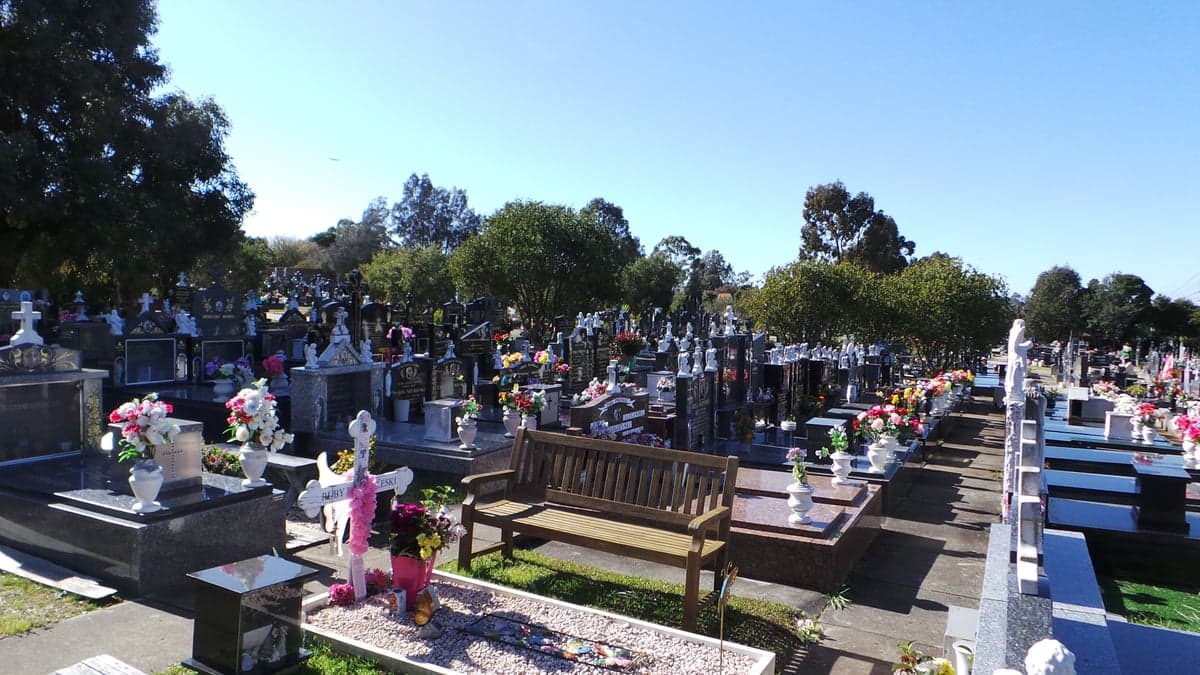
Binstock & Sons builds Macedonian Orthodox monuments across every major Sydney cemetery — Rookwood, Woronora Memorial Park, Frenchs Forest, and Macarthur Memorial Park. Our masons know each cemetery's specific rules around dimensions, materials and ceramic photographs.

For a full overview of our Macedonian monument work, see our Macedonian Headstones page →

Questions

Frequently Asked Questions

Do we need to include Cyrillic on the monument?

For traditional Macedonian Orthodox families, Cyrillic is essential — particularly for the name and the closing "Вечна памјат". Younger generations sometimes opt for more English content, but the majority of Macedonian monuments we build are bilingual, with Cyrillic script alongside English. We can help you decide on the balance.

How do you handle Cyrillic characters in the engraving?

Our engraving equipment supports the full Macedonian Cyrillic character set. We prepare a detailed proof of every inscription and send it to the family for approval — often to a Macedonian-speaking family member or the parish priest — before engraving begins. Nothing is cut until you sign off.

How does the ceramic photograph process work?

You supply us with a high-quality photograph of the deceased. We work with a specialist ceramicist who fires the image onto porcelain in oval or rectangular format. The finished ceramic is then mounted onto the monument. Ceramic photos last 50+ years outdoors and can be replaced or added later if needed.

Can we include the family's village or region in Macedonia?

Absolutely, and we encourage it. It's one of the most meaningful details on a Macedonian monument, particularly for first- and second-generation families. The town name is typically included in Cyrillic (e.g. "Роден во Битола, Македонија") near the dates.

What if we want to install the monument before the 40-day memorial?

This is very common for Macedonian families and we understand the importance of the timing. In most cases we can complete a monument within 4–6 weeks of the order, provided the design is finalised quickly and cemetery ground conditions permit. Get in touch as soon as possible after the funeral if this is your goal.

Can you include a Macedonian Orthodox saint or icon?

Yes. Whether it's Saint Clement of Ohrid, Saint Naum, the Theotokos, or a saint particular to your family's town or parish, we can etch or carve the image into the monument, or include it as a ceramic panel. Bring us a reference image and we design the monument around it.

Do you coordinate the blessing with our parish priest?

Yes. After installation, we coordinate with your family's parish so the priest can perform the blessing (osvetuvanje) at a time that suits — often around the 40-day memorial. The blessing typically takes 15–20 minutes graveside with prayers, incense and holy water.
Get in Touch

Ready to speak with us?

Our experienced masons help Sydney Macedonian Orthodox families through every step of the memorial process — Cyrillic and English wording, ceramic photography, Orthodox iconography, and coordination with your parish priest ahead of the 40-day memorial.

Call (02) 9746 7696