Binstock & Sons
Memorials
Polish Catholic Memorial Guidance

Polish Headstone Wording
Inscriptions & Traditions

A complete guide to Polish Catholic monument wording, inscriptions, symbols, and traditions. Family-run monumental masons serving Sydney's Polish community since 1958.

Call (02) 9746 7696

Finding the Right Words

This guide covers what typically appears on a Polish Catholic monument in Sydney — the structure of the inscription with correct diacritical characters, the symbols at the heart of Polish memorial design, and the traditions around blessings and anniversary observances.

We've built Polish Catholic monuments across Rookwood, Liverpool, North Rocks, Field of Mars and Macarthur Memorial Park for more than 65 years. To discuss your family's memorial, call us on (02) 9746 7696.

Inscription

Elements of a Polish Inscription

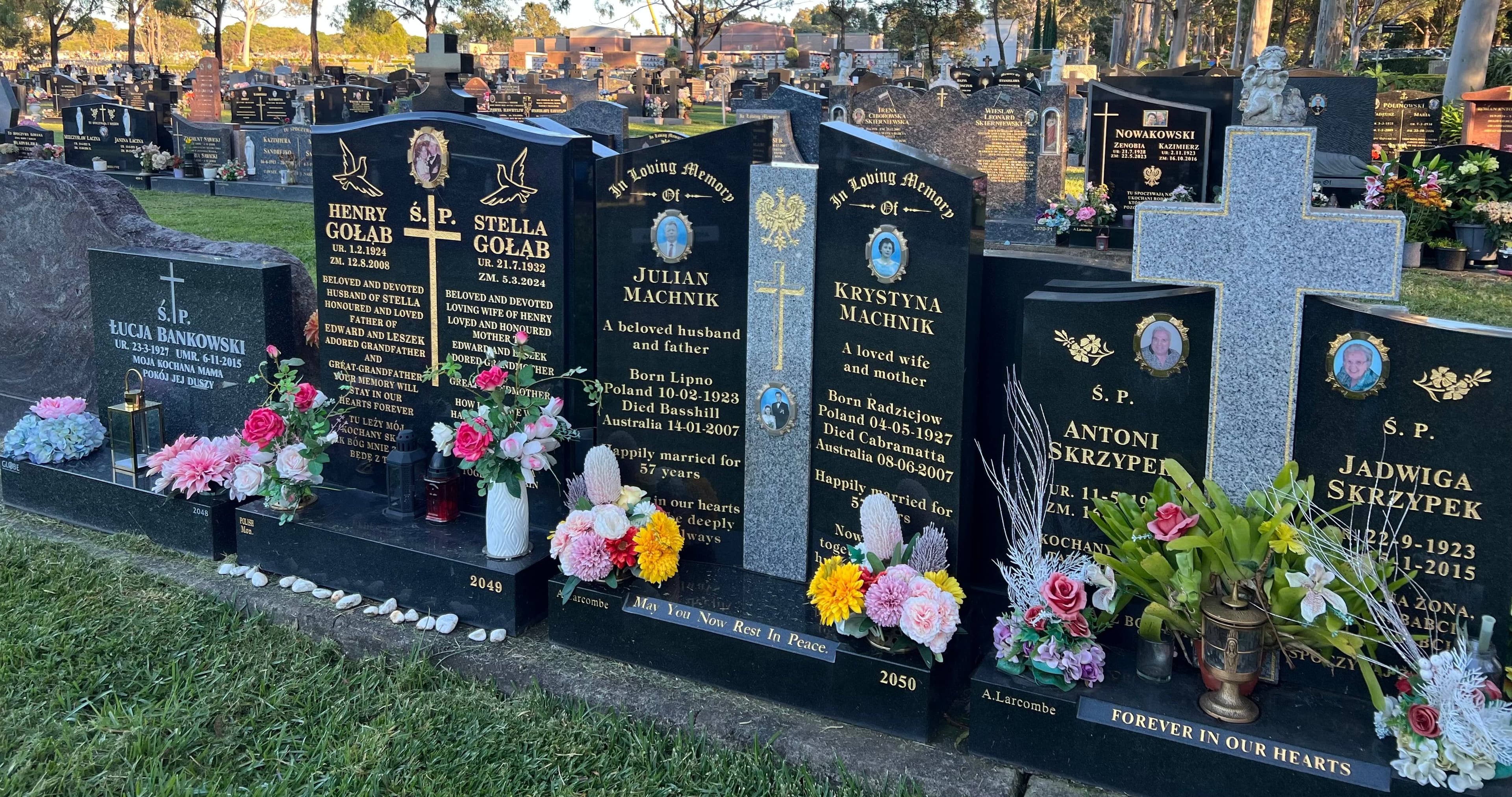
Polish monuments in Sydney typically include both Polish and English phrasing, with a strong emphasis on family, faith, and heritage. The elements below appear on the majority of monuments we build for Polish families.

Full name (with correct diacritics)

The full baptismal name of the deceased, with correct Polish spelling and diacritical marks (ł, ż, ą, ć, ę, ń, ó, ś, ź). Polish surnames typically differ by gender — masculine forms end in -ski, feminine in -ska (e.g. Kowalski / Kowalska). We prepare a full proof of the inscription for family review before any engraving begins to ensure every character is correct.

Opening phrase — "Świętej Pamięci"

"Świętej Pamięci" (abbreviated "Ś.P." or "śp.") means "of blessed memory" or "of holy memory" and is the traditional Polish opening on almost every Polish Catholic monument. It precedes the name — for example, "Ś.P. Jan Kowalski". English equivalents such as "In loving memory of" and "In blessed memory of" are also used, particularly on bilingual monuments.

Dates of birth and death

Both dates are typically included, formatted as DD.MM.YYYY (European style) or DD/MM/YYYY. Traditional Polish inscriptions may include "ur." (urodzony/urodzona — "born") and "zm." (zmarł/zmarła — "died") before each date.

Place of birth in Poland

Many first- and second-generation Polish-Australian families include the deceased's birthplace in Poland — a town, village or region — as a heritage anchor. Common formats: "Urodzony w [town], Polska" ("Born in [town], Poland"), or simply the town name below the dates. This is a strong tradition worth preserving even for later generations.

Family relationship

Polish monuments almost always list surviving family — "Kochany mąż i ojciec" ("Beloved husband and father"), "Ukochana żona i matka" ("Beloved wife and mother"), or the English equivalents. Children and grandchildren are commonly listed by name. This centres the monument on family, which is core to Polish memorial tradition.

Closing phrase — "Wieczny odpoczynek"

"Wieczny odpoczynek racz mu/jej dać Panie" ("Eternal rest grant unto him/her, O Lord") is the traditional Polish Catholic closing, drawn from the Requiem. Common shorter closings include "Spoczywaj w pokoju" ("Rest in peace"), "R.I.P.", or "Requiescat in Pace". Many monuments add "Prosimy o modlitwę" ("We ask for a prayer") as a plea for prayers from visitors.

Military and community service (where applicable)

Sydney's Polish community includes many WWII veterans, Home Army (Armia Krajowa) members, and post-war political refugees. Where relevant, families often include a small notation of military service, unit, or specific historical contribution — an important honour on the monument of the wartime generation.

Symbolism

Symbols & Iconography

Polish Catholic monuments carry symbols that speak to both faith and national identity — the Latin cross, the Black Madonna, Pope John Paul II, and imagery specific to Poland's religious and historical heritage.

Latin cross (Krzyż)

The Latin cross is the primary symbol on almost every Polish Catholic monument. Plain, ornate, or as a crucifix with the corpus of Christ. Standing crosses at the top of the headstone are particularly traditional in Polish design.

Our Lady of Częstochowa (Matka Boska Częstochowska)

The Black Madonna of Częstochowa is the patron saint of Poland and one of the most venerated Marian images in the Catholic world. Etched or ceramic images of Our Lady of Częstochowa appear on many Polish monuments, particularly for older-generation families. Her image is deeply tied to Polish national identity, not just religious devotion.

Pope John Paul II (Jan Paweł II)

Since his canonisation in 2014, images or a small portrait of Saint John Paul II — the Polish-born pope — have become increasingly common on Polish monuments, particularly for those with a strong personal devotion to him.

Sacred Heart (Serce Jezusa)

The Sacred Heart of Jesus, common across Catholic traditions, is popular on Polish monuments. Often paired with the Immaculate Heart of Mary (Serce Maryi) on monuments for devoted couples.

Ceramic photograph (Portret ceramiczny)

Ceramic photographs are widely used on Polish monuments in Sydney, in oval or rectangular formats. Fired onto porcelain and mounted directly to the granite, they last 50+ years outdoors. Common for both individual and couple portraits.

Praying hands and rosary (Różaniec)

Praying hands wrapped with rosary beads are a strong Polish Catholic symbol, reflecting the central role of the rosary in Polish devotional life. Particularly common for elderly parishioners known for daily prayer.

Polish military and heritage symbols

The Polish White Eagle (Orzeł Biały) sometimes appears on monuments for veterans or those with strong national feeling. Military insignia — particularly for Home Army, Solidarity or WWII veterans — may be included alongside a brief note of service.

Patron saints

Images of the deceased's patron saint (imiennik / imienniczka) — the saint of their name — are commonly incorporated. Saint Stanislaus, Saint Adalbert, Saint Faustina Kowalska, and Saint Maximilian Kolbe are particularly meaningful to the Polish community.

Traditions

Timing, Blessings & Anniversary Customs

Timing of installation

Polish Catholic families typically install a monument between 6 and 12 months after burial, though there is no strict theological deadline. Many families aim to have it in place before the first anniversary of death (rocznica śmierci) so the monument is present for the anniversary mass. Some install earlier around All Souls' Day (Wszystkich Świętych) if that anniversary is approaching.

Blessing by the parish priest (poświęcenie pomnika)

Most Polish Catholic families arrange for their parish priest to bless the monument after installation. The blessing is brief — sprinkling of holy water, prayers for the deceased and family, sometimes a short reading. We coordinate installation timing with the family's parish so the blessing can proceed shortly after.

All Saints' and All Souls' Day (Wszystkich Świętych / Zaduszki)

The Polish tradition around All Saints' Day (Nov 1) and All Souls' Day (Nov 2) is among the most important observances in the community calendar. Families gather at graves in force, lighting candles (znicze) that transform Polish cemeteries into seas of flame after dark. The monument becomes the focal point for this annual gathering. Many families plan installations so the monument is complete before their first Wszystkich Świętych.

Anniversary masses (Msza rocznicowa)

Polish Catholic tradition places strong emphasis on the anniversary mass held annually. Families often visit the grave the same day, leaving flowers and lighting candles. The monument is central to the ritual — a permanent gathering place for the family.

The wartime and post-war generations

Sydney's Polish community was significantly shaped by post-WWII refugees — Home Army veterans, Solidarity-era emigrants, and displaced persons from across Poland. Their monuments often carry particular weight — military service, resistance history, or the town of origin lost to displacement. We treat these monuments with the historical sensitivity they deserve.

Where We Work

Every Polish Section in Sydney

Binstock & Sons builds Polish Catholic monuments across every major Sydney cemetery — Rookwood, Liverpool, North Rocks, Field of Mars, and Macarthur Memorial Park. Our masons know each cemetery's specific rules around dimensions, materials and ceramic photographs.

For a full overview of our Polish monument work, see our Polish Headstones page →

Questions

Frequently Asked Questions

Do we need to include Polish on the monument?

Not required, but the majority of Polish monuments we build include at least some Polish phrasing — the opening ("Ś.P."), the closing ("Wieczny odpoczynek"), a birthplace, or family relationships. It's a meaningful anchor to heritage and honours older-generation family members. Fully bilingual monuments are the standard.

How do you handle Polish diacritical characters?

Our engraving equipment supports the full Polish character set (ł, ż, ą, ć, ę, ń, ó, ś, ź). We prepare a detailed proof of every inscription and send it to the family for approval — often to a Polish-speaking family member or the parish priest — before engraving begins. Nothing is cut until you sign off.

How does the ceramic photograph process work?

You supply us with a high-quality photograph of the deceased. We work with a specialist ceramicist who fires the image onto porcelain in oval or rectangular format. The finished ceramic is then mounted onto the monument. Ceramic photos last 50+ years outdoors and can be replaced or added later if needed.

Can you include Our Lady of Częstochowa or another Polish patron saint?

Yes. Whether it's Our Lady of Częstochowa, John Paul II, Saint Faustina, Saint Maximilian Kolbe, or a saint particular to your family's town in Poland, we can etch or carve the image into the monument, or include it as a ceramic. Bring us a reference image and we design the monument around it.

Can we include the family's town in Poland?

Absolutely, and we encourage it. It's one of the most meaningful details for first- and second-generation Polish-Australian families. The town name is typically included in Polish (e.g. "Ur. w Krakowie, Polska") near the dates.

How is the monument blessed by the priest?

After installation, we coordinate with your family's parish so the priest can perform the poświęcenie at a time that suits the family. The blessing takes 10–15 minutes graveside — prayers, holy water, sometimes a short scripture reading. We time the installation so the blessing can happen shortly after.

Do you build monuments in the Polish Catholic sections at Rookwood and Liverpool?

Yes. We've built Polish Catholic monuments across every major Sydney cemetery for over 65 years, including Rookwood (Polish sections), Liverpool, North Rocks, Field of Mars, and Macarthur Memorial Park. We know each cemetery's specific rules and design accordingly.
Get in Touch

Ready to speak with us?

Our experienced masons help Sydney Polish families through every step of the memorial process — Polish and English wording with correct diacritics, ceramic photography, patron saint imagery, and coordination with your parish priest.

Call (02) 9746 7696