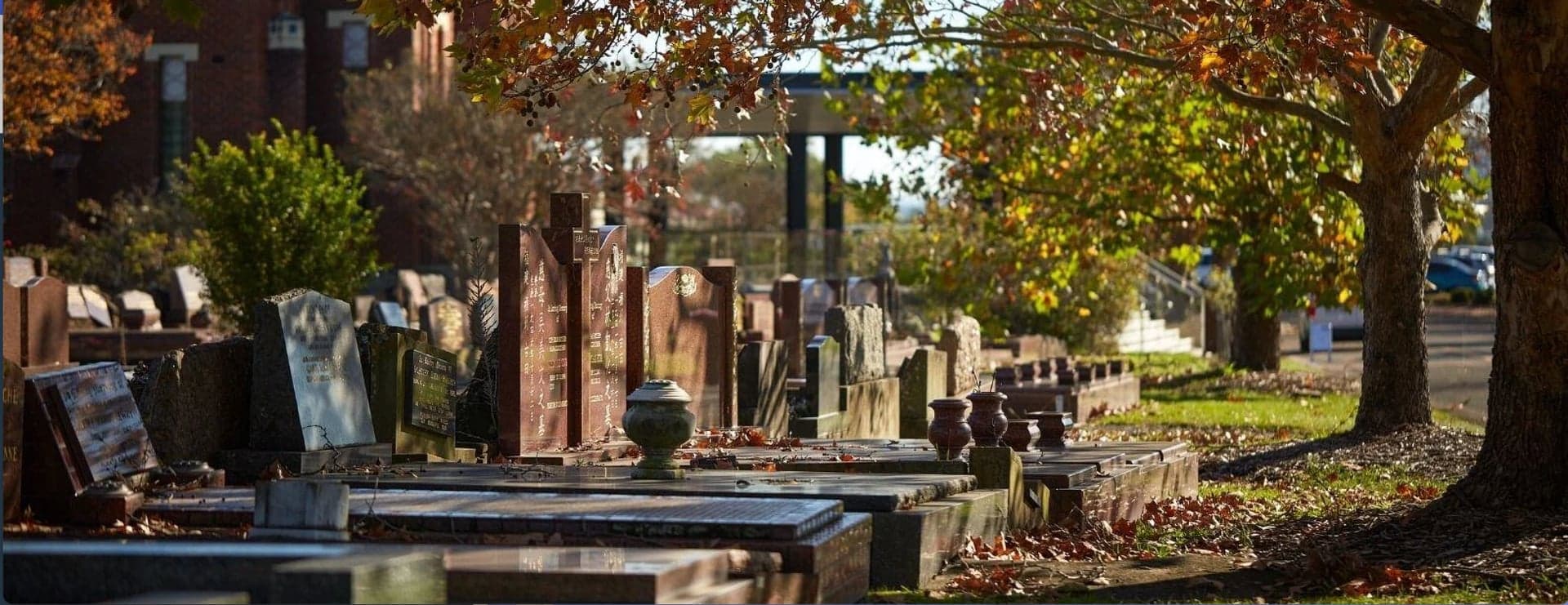
A complete guide to Protestant monument wording, scripture verses, symbols and denominational traditions. Serving Anglican, Presbyterian, Methodist, Baptist, Uniting and other Protestant families across Sydney since 1958.
This guide covers what typically appears on a Protestant monument in Sydney: the structure of the inscription, the scripture verses most families choose, the visual symbols across denominational traditions, and the customs around blessing and anniversary observances.
We've built Protestant monuments across every major Sydney cemetery — Rookwood, Macquarie Park, Woronora, Field of Mars, Waverley, and Macarthur Memorial Park — for more than 65 years. To discuss your family's memorial, call us on (02) 9746 7696.
Protestant monuments follow a recognisable structure, though styles vary meaningfully between denominations. The elements below appear on the majority of monuments we build for Anglican, Presbyterian, Methodist, Baptist and Uniting Church families.
The most common Protestant openings are "In loving memory of," "In cherished memory of," "In grateful memory of," and "Sacred to the memory of." Simpler still, many Anglican and Presbyterian monuments open with just the name in large lettering — dignified and restrained, characteristic of Protestant memorial tradition.
The full legal name of the deceased, as commonly used during their lifetime. Middle names are often included in full — a traditional Anglican and Presbyterian practice. Some families include a nickname or preferred name in parentheses alongside the formal name.
Both dates are typically included, formatted DD Month YYYY or DD/MM/YYYY. Traditional inscriptions may include "Born" and "Died" before each date, though modern monuments often just show the dates alongside the name. Some families use "In the Year of Our Lord" or "A.D." before the death date on more formal monuments.
"Beloved husband and father of…," "Devoted wife, mother and grandmother," "Adored son and brother" — the relationship of the deceased to the family is a central element of Protestant inscriptions. Sons, daughters, grandchildren and sometimes great-grandchildren are commonly listed. In some Presbyterian and Anglican traditions, godchildren may also be included.
A short Bible verse or line from a hymn is one of the defining features of Protestant monuments. Popular choices include Psalm 23 ("The Lord is my Shepherd"), John 14:2 ("In my Father's house are many mansions"), John 3:16, Revelation 21:4, and lines from hymns like "Abide with Me," "Rock of Ages," or "Amazing Grace." See the scripture examples section below for specific options.
"At rest," "Called to glory," "At peace with God," "Safe in the arms of Jesus," "Until we meet again," "In God's loving care," and "Home at last" are among the most common Protestant closings. Traditional inscriptions sometimes close with "R.I.P." (though this is more Catholic in origin), or with a simple "Amen."
The choice of scripture verse is often the most personal decision in a Protestant monument design. The passages below appear most frequently on the monuments we build.
"The Lord is my Shepherd, I shall not want." "He leadeth me beside the still waters. He restoreth my soul." "Though I walk through the valley of the shadow of death, I will fear no evil, for Thou art with me." The most widely-used Bible passage on Protestant monuments across every denomination.
"Let not your heart be troubled: ye believe in God, believe also in me. In my Father's house are many mansions." A comforting Gospel passage particularly common on Anglican and Methodist monuments.
"For God so loved the world, that he gave his only begotten Son, that whosoever believeth in him should not perish, but have everlasting life." Central to evangelical Protestant faith, commonly included on Baptist and non-denominational monuments.
"And God shall wipe away all tears from their eyes; and there shall be no more death, neither sorrow, nor crying, neither shall there be any more pain: for the former things are passed away." A tender passage often used on children's monuments and those honouring long lives.
"I have fought a good fight, I have finished my course, I have kept the faith." Often chosen for monuments of long-serving pastors, ministers, elders, and devoted lay members.
"Amazing grace, how sweet the sound." "Rock of Ages, cleft for me, let me hide myself in Thee." "Abide with me, fast falls the eventide." Lines from beloved hymns sit naturally on Protestant monuments and often carry as much emotional weight as scripture.
Protestant memorial iconography ranges from very restrained (in Reformed and Evangelical traditions) to more decorative (in Anglican and Anglo-Catholic traditions). The most-used symbols across Sydney include:
The plain Latin cross is the most common symbol on Protestant monuments — one vertical bar, one horizontal crossbar, unadorned. It appears across every Protestant denomination. Ornate variations (Celtic crosses, cross flèche) are used in some Anglican traditions.
The cross with a ring at the intersection carries strong Anglican and Presbyterian associations, particularly for families of Scottish, Irish or Welsh Protestant heritage. Common on monuments in the older heritage sections of Rookwood, Waverley and Field of Mars.
An open Bible carved into the monument — sometimes with a specific verse reference shown — is a distinctly Protestant symbol reflecting the sola scriptura ("scripture alone") tradition central to the Reformation. Common on Presbyterian, Baptist and evangelical monuments.
The dove — representing the Holy Spirit, peace, and the soul's ascent to heaven — is widely used across all Protestant denominations. Often shown carrying an olive branch (echoing Noah's Ark and the promise of restoration).
Two hands clasped in prayer, often based on Dürer's famous engraving. A universal Christian symbol appearing across Catholic and Protestant traditions alike.
"We have this hope as an anchor for the soul" (Hebrews 6:19). The anchor is a traditional Christian symbol of steadfast faith, appearing on some Methodist, Presbyterian, and non-denominational monuments — particularly for those with a naval or maritime background.
The letters IHS — a Latin transliteration of the first three letters of the Greek name for Jesus (ΙΗΣ) — appear on some Anglican monuments, particularly those in the more liturgical Anglo-Catholic tradition. Less common on Reformed and Evangelical monuments.
Roses, lilies, wheat sheaves (for a life well-lived), oak leaves (strength), and simple floral motifs are commonly used, particularly on Protestant monuments that prefer restraint over explicit religious iconography. Reflects the Protestant preference for dignity and simplicity.
Protestant memorial tradition, particularly in the Reformed streams (Presbyterian, Methodist, Baptist, Uniting), emphasises simplicity and dignity over elaborate ornamentation. Clean lines, quality granite, restrained iconography, and a well-considered scripture verse are the hallmarks of this style. This reflects the theological emphasis on "the substance rather than the show."
Anglican monuments range from the very simple (in Low Church / Evangelical Anglican tradition) to more elaborate liturgical designs (in Anglo-Catholic tradition) featuring detailed crosses, IHS monograms, and more decorative elements. We tailor to the family's specific parish tradition.
Protestant families typically install a monument between 3 and 12 months after burial, with no strict theological deadline. Many families aim to have it in place before the first anniversary of death (an anniversary widely observed across Protestant traditions). Some choose to install sooner around Easter, when families often visit graves in force.
Some Protestant families arrange for their minister or vicar to conduct a brief graveside dedication after installation — a short prayer, scripture reading, and blessing of the monument. This is less formalised than Catholic traditions but remains a meaningful moment for many families. We coordinate our installation timing with your church so the dedication can proceed shortly after.
Sydney's Protestant community includes Anglican, Presbyterian, Methodist, Baptist, Uniting Church, Lutheran, Pentecostal and independent evangelical families. Each carries its own traditions — Anglican monuments often more decorative, Baptist typically more scripture-focused, Presbyterian generally simpler and restrained. We adapt to your family's specific tradition.
Many Protestant sections at Sydney's older cemeteries (Rookwood, Waverley, Field of Mars) contain heritage monuments in sandstone or marble requiring careful restoration and matched additions. Our masons have decades of experience working with heritage materials in these sections.
Binstock & Sons builds Protestant monuments across every major Sydney cemetery — Rookwood (Anglican, Presbyterian, Methodist, Baptist sections), Macquarie Park, Woronora, Field of Mars, Waverley (heritage Anglican sections), and Macarthur Memorial Park. Our masons know each cemetery's specific rules including heritage restoration in older sections.
For a full overview of our Protestant monument work, see our Protestant Headstones page →
The most common approaches: choose a verse the deceased loved (Psalm 23 is by far the most-used), select a line from a hymn sung at the funeral, ask your minister or vicar for a suggestion based on the funeral service readings, or choose based on the family's tradition. We can also provide a shortlist of the most commonly-used Protestant epitaphs if that helps.
Anglican monuments range from simple to elaborate depending on parish tradition (Low Church vs Anglo-Catholic). Presbyterian monuments tend toward simplicity and dignity, often with an open Bible or Celtic cross. Methodist monuments favour clean design with scripture prominent. Baptist monuments typically feature strong scripture emphasis and simpler iconography. We tailor to your family's specific denomination.
Not strictly required, though it's included on the majority of Protestant monuments as a mark of Christian faith. Some families prefer just the scripture verse and the deceased's name, no cross — particularly in more Reformed traditions that historically avoided iconography. Your call.
Yes, though R.I.P. (Requiescat in Pace) is more Catholic in origin — most Protestant families prefer English phrasing ("At rest," "Called to glory," "At peace with God") or scripture. Anglo-Catholic Anglican monuments sometimes use Latin phrases; other Protestant traditions typically don't.
Yes, at most Sydney cemeteries. Ceramic photos are less traditional on Protestant monuments than on Catholic or Orthodox monuments, but many families include them. Some heritage Anglican sections have specific rules — we check the requirements for your specific cemetery section before design begins.
Yes — this is very common. Additional inscriptions (for a spouse, sibling or child added to a family monument later) are engraved on-site at the cemetery once the details are known. Design the monument with future inscriptions in mind if this is a consideration.
Not required, though some Protestant families choose to have their minister or vicar conduct a brief graveside dedication after installation. It's a short, meaningful ceremony — usually a prayer, scripture reading and blessing. Less formalised than the Catholic tradition. We can coordinate installation with your church's schedule if you'd like.
Our experienced masons help Sydney Protestant families through every step of the memorial process — inscription wording, scripture selection, denominational symbols, and coordination with your minister or vicar.